Resilience, acceptance and gratitude for caring and skilled professionals
‘Now it was my turn to be on the other side’. Retired Fellow Dr Alan Broomhead’s son Andy was involved in a motor bike accident late last year and had a right below-knee amputation. The former Director of Emergency Medicine Training at Adelaide’s The Queen Elizabeth Hospital reflects on his family’s journey from the day of the accident to where his son is now, mobile on his prosthetic leg, the exceptional care he received in the ED and beyond, and how this experience has affected them all.
It began as an unexceptional December day. I had been retired from Emergency Medicine for two and half years. Life was good and retirement was wonderful. One of my daughters-in-law, Monika, phoned asking “Has the ambulance called you?”
“No, why?” I responded.
“He’s been in a motor bike accident and they said that his leg’s hanging off and they’re taking him to the Royal Adelaide Hospital”
“It’s Andy”, she said.
My immediate thought was “What’s he done now?” My middle son Andy has always been accident prone. Monika replied with, “He’s been in a motor bike accident and they said that his leg’s hanging off and they’re taking him to the Royal Adelaide Hospital”.
My reflex response was that I’m sure that’s an exaggeration, he’s probably just got an injured leg and he’ll be fine. Fortunately, Monika works just a few minutes’ drive from me so she picked me up in her car and we went to the hospital.
‘It wasn’t good’
I felt very relaxed as we parked. I said to Monika, “You go to triage and let them know that we’re here”. I was happy to sit in the waiting room, chill out, and thought we’ll go in and see Andy soon and take him home later.
Monika called out from triage that the doctor was coming out to take us in. I thought that’s not good. I walked over to see one of the ED consultants who I knew. He ushered us in to a room. I now knew that it wasn’t good. He asked, “What do you know?” in reference to Andy’s arrival in the ED.
“I walked over to see one of the ED consultants who I knew. He ushered us in to a room. I now knew that it wasn’t good. He asked, “What do you know?” ... This was not looking good at all. I had done it many times myself. Now it was my turn to be on the other side as a patient’s relative.”
This was not looking good at all. I had done it many times myself. Now it was my turn to be on the other side as a patient’s relative.
Monika said that we knew that Andy had been in an accident and that his leg was injured. The ED consultant explained that the right leg was probably not salvageable. He went outside to get the trauma surgeon and the anaesthetist.
“We sat there in silence taking it in. They both explained in the most empathetic way that Andy’s right leg was amputated, confirmed that it was not salvageable, that there had been significant haemorrhage, that he was intubated and currently in the CT scanner and that he would need a right below knee amputation. ”
We sat there in silence taking it in. They both explained in the most empathetic way that Andy’s right leg was amputated, confirmed that it was not salvageable, that there had been significant haemorrhage, that he was intubated and currently in the CT scanner and that he would need a right below knee amputation. They also said that this was likely to be an isolated injury but the pan scan would confirm that. They would take him directly from CT to theatre.
We were asked whether one of us would sign consent for the amputation or whether we preferred two-doctor consent. My reflex was that I didn’t want to consent to my son’s leg being amputated and neither should his wife. We opted for two-doctor consent.
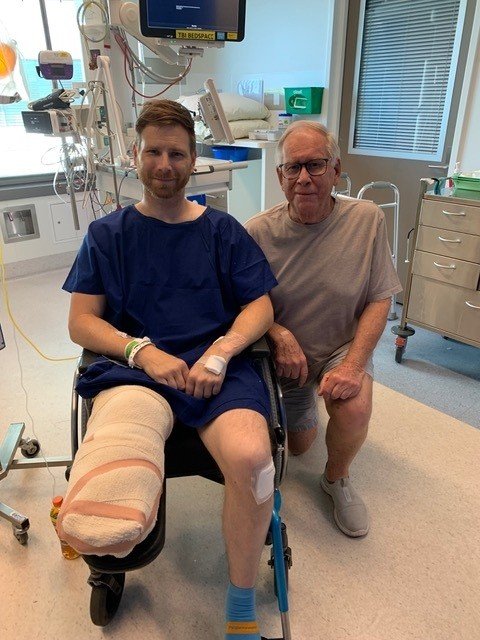
Retired FACEM Dr Alan Broomhead and his son Andy following his surgery.
Going into ‘business mode’
At that point I felt no emotion. I knew that he was being cared for, that what he needed was being done and there was nothing further that we could do. Monika and I went into business mode. We took Andy’s belongings and went to my house.
We divided up the tasks that needed to be done. We needed to let people know – family and workplace, where was the bike and what should we do about it? “What else?” we asked. I let my family and Andy’s boss know, I would liaise with the police and I would find out where his bike was. Monika had other tasks.
Stable condition
The trauma surgeon had said that he would phone me after the operation. Later that day he confirmed that they had performed the amputation, debrided the wound which was left open, and that Andy was stable and in ICU. He also confirmed that the pan scan was normal. We decided not to go in that day knowing that Andy would remain intubated overnight but we would visit the following day.
“The investigating officer phoned me back the day after. He said that a car had turned in front of Andy, hitting him on his right side while he was travelling at 50-55 km/h. ”
I had contacted the police at the station closest to where the accident happened. The investigating officer phoned me back the day after. He said that a car had turned in front of Andy, hitting him on his right side while he was travelling at 50-55 km/h. There was dashcam footage from the car travelling behind. Andy was not at fault – a minor relief.
One of my tasks was to find out where the bike was and to dispose of it. The bike was at a crash repairers who would take it and deal with it at no cost to us – also a minor relief.
Visiting time
We worked out an informal visiting schedule so that the family were not there all at the same time and visiting was spaced out during the day. I visited every second day. For the first few days in ICU Andy was on a ketamine infusion and well sedated. Walking into ICU for the first time was sobering. His right leg was clearly missing under the sheets and he was connected to a lot of tubes.
“On a white board was written his name and “Traumatic Amputation” with the number of units of blood and FFP he had received. Yes, that’s what it was, I thought – a traumatic amputation. I hadn’t really considered that before. ”
On a white board was written his name and “Traumatic Amputation” with the number of units of blood and FFP he had received. Yes, that’s what it was, I thought – a traumatic amputation. I hadn’t really considered that before. OMG!
Each time I visited more tubes had come out – catheter, arterial line, second IV and so on. This was encouraging as it meant he was improving. Orthopaedics took him to theatre on the fifth day where they debrided the stump, shortened the bone by 1.5cm and closed the wound.
Andy spent a week in ICU before being transferred to the orthopaedic ward. During the second week plastic surgery did a targeted muscle reinnervation (TMR) procedure to prevent, or at least reduce, phantom limb pain. A week later he was transferred to the rehabilitation unit at The Queen Elizabeth Hospital (TQEH). They ensured that he was sufficiently mobile on crutches for discharge and that appropriate supports would be in place at home.
Discharge day
He was discharged from TQEH less than three weeks after the accident. He had analgesia along with pregabalin for neuropathic pain. Andy was getting electric shock-like sensations in the stump and lower thigh.
On the day of discharge, he was accompanied by an occupational therapist and a physiotherapist from the rehabilitation unit. They provided a wheelchair and shower chair and made some recommendations for ease of mobility and safety around the house. A couple of his friends had already moved a bed downstairs where there was a separate bathroom. I realised that there were a lot of things to consider.
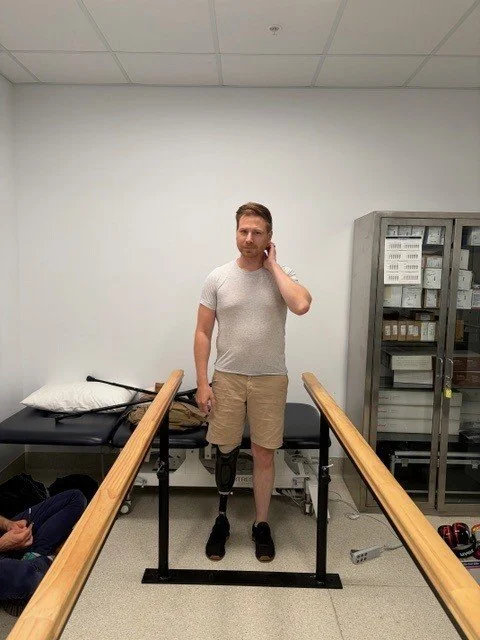
Andy during rehab with his newly fitted prosthetic leg.
While on crutches, getting out of bed in the morning and making a cup of coffee seemed an insurmountable task for him. Small tasks were difficult and frustrating, such as trying to cook something. Have you tried to take the garbage out or collect the mail on one leg and with crutches? Answering the doorbell in a reasonable time was not possible.
Back to work
Andy went back to work from home four weeks after his accident. He’s a software engineer and could do that. His company has been extremely supportive. The neuropathic pain gradually abated to the point where he no longer needed pregabalin. The TMR was working.
“He’s now almost as mobile as the rest of us. He negotiates the stairs at home with ease, takes the dog for a walk and goes to the gym. He can jump but not yet run. ”
His prosthetic leg was fitted at the Specialist Ambulatory Rehabilitation Centre (SpARC) at Modbury Hospital 14 weeks after the accident once the stump had healed sufficiently and the swelling had resolved. They see him regularly and can make adjustments to the prosthesis as needed.
He’s now almost as mobile as the rest of us. He negotiates the stairs at home with ease, takes the dog for a walk and goes to the gym. He can jump but not yet run. Andy’s not yet quite ready to go back to Thursday evening basketball or Saturday cricket for the local club but watch this space. He has just passed his driving test in an automatic car. There are no plans for another motor bike.
He has been accepted into the Compulsory Third Party (CTP) Lifetime Support Scheme. That provides ongoing medical care, prosthetics, physiotherapy, occupational therapy, psychological support, transport and support around the house. There is a dedicated case worker. I will never grumble when I pay my motor vehicle registration and CTP again.
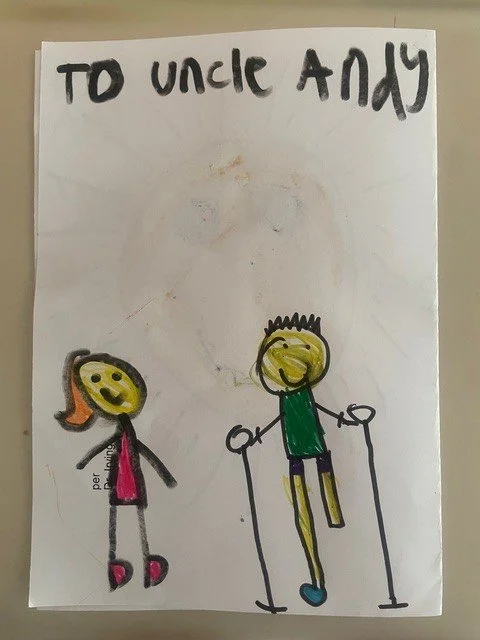
There were some light-hearted moments. A few days after the accident, Frankie, one of my granddaughters (age six), sent Uncle Andy a get well card. She had drawn him with only one leg but it was the left leg that was missing rather than the right. It’s the thought that counts.
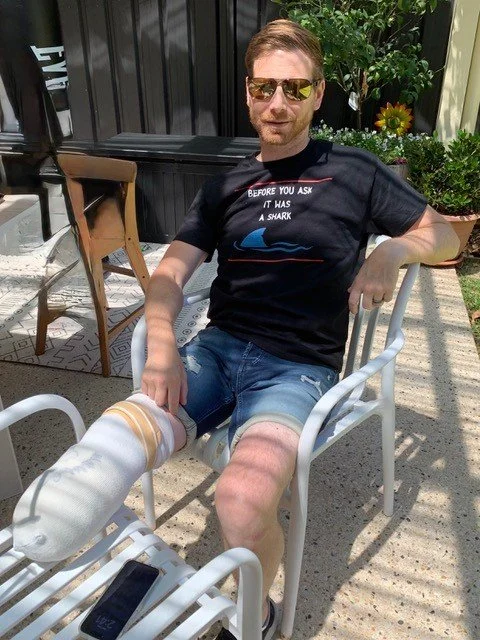
At the first family lunch after Andy’s accident while he was still on crutches, my youngest and mischievous son presented him with a T shirt that said, “Before you ask, it was a shark”.
“He wasn’t scared. He knew that he was where he needed to be and was safe.”
Andy’s recollections of that morning remain very clear. He remembers the ambulance ride being very uncomfortable.
At the RAH he was taken straight into an operating theatre with lights overhead (the resuscitation room) and a lot of people. He asked if he was going to die and was reassured that he was not. He wanted to see his seven-year-old daughter Zoe again.
He wasn’t scared. He knew that he was where he needed to be and was safe. He also knew the leg was mangled and agreed to be intubated and go to theatre.
Gratitude and strength
What did I learn from this experience? It was resilience, acceptance and being grateful for the caring and skilled professionals that we have as our first responders, in our EDs, in ICU and the ward, and in rehabilitation. We were always treated in the most caring and empathetic way. I cannot thank enough the staff in the RAH ED who saved Andy’s life. I will be forever grateful.
“We were always treated in the most caring and empathetic way. I cannot thank enough the staff in the RAH ED who saved Andy’s life. I will be forever grateful.”
I learned some things about myself. I was stronger than I thought I could be in this situation. Perhaps it was my training in emergency medicine, perhaps not. I remember everything of those first few days with absolute clarity. I accepted what had happened. I was grateful for the care that Andy was given, from the ambulance arriving to his ongoing care now at SpARC. I never shed a tear. What had happened was irreversible and we just needed to accept it, deal with it, make the best of it and move on.
“I learned that what we do in the ED is not necessarily the most important part of the journey for the patient and their family but just a small part of it. There is much more just as important.”
I learned that what we do in the ED is not necessarily the most important part of the journey for the patient and their family but just a small part of it. There is much more just as important. The true journey starts at discharge at home when you are trying to get your life back to something that resembles normal.
‘What if …?’
I also learnt that the major issues after amputation are not only mobility but cosmesis and psychological. Cosmesis never seemed much of an issue for Andy. I guess that in a way it was a badge of honour that “I’ve come through this and I’ve survived”.
The psychological side was more insidious: “What if I hadn’t worked from home that morning, what if I hadn’t decided to ride the bike, what if …?”. There are no answers to those questions.
“We have a marvellous medical and hospital system. It has its faults. All systems do. However, when a patient needs critical and ongoing care, that care is based on need. It’s not based on status or ability to pay. We need to thank our system every day for the service and care it provides to our patients and to the families who need it. ”
We have a marvellous medical and hospital system. It has its faults. All systems do. However, when a patient needs critical and ongoing care, that care is based on need. It’s not based on status or ability to pay.
We need to thank our system every day for the service and care it provides to our patients and to the families who need it. Andy certainly did on that unexceptional December day. I am forever grateful.