Dr Peter Burke: A Foundation Fellow’s recollections of ACEM’s beginnings
Foundation Fellow Dr Peter Burke reminisces about the circumstances leading to the founding of the Australasian College for Emergency Medicine (ACEM).
The ‘Ash Wednesday Fires’ occurred on 16 February 1983: over the 12-hour rampage, more than 180 fires, fanned by winds of up to 110 km/h, caused widespread destruction across Victoria and South Australia. In Victoria, 47 people died, while in South Australia there were a further 28 deaths.
Shortly after this catastrophic event, on April 13, 1983, at the State Film Centre in East Melbourne, I delivered the Medox ‘Lecture of the Month’, ‘Disasters and Aspects of Their Management’ before a capacity audience.
The American College of Emergency Physicians (ACEP) was founded in August 1968 in Lansing, Michigan, and had emerged in response to the growing need for specialised emergency medical care and the desire to establish emergency medicine as a recognised medical specialty.
In 1972 the American Medical Association (AMA) recognised emergency medicine as a specialty and subsequently the American Board of Emergency Medicine (ABEM) and the Society for Academic Emergency Medicine (SAEM) were established. In 1979 the American Board of Medical Specialties (ABMS) granted full specialty status to emergency medicine.
“Since the mid-1970s the term ‘golden hour’ refers to the first hour after a traumatic injury, during which prompt and appropriate medical care is crucial for maximising the chances of survival and minimising long-term complications. ”
Since the mid-1970s the term ‘golden hour’ refers to the first hour after a traumatic injury, during which prompt and appropriate medical care is crucial for maximising the chances of survival and minimising long-term complications. This concept emphasises the urgency of rapid assessment, treatment, and transportation of trauma patients to a trauma centre: a new phrase also entered medical terminology then, ‘patterns of injury’. Times were changing, fast.
At that time the Association of Casualty Supervisors of Victorian Hospitals (ACSVH) had evolved, becoming the first group in Australia to focus on emergency medicine as a discipline.
In 1978, following proclamation of the Health Commission Act 1977, the Health Commission of Victoria was established. This represented a major re-organisation of health services in Victoria and for the first time responsibility for the central administration of health services rested with a single agency.
In September 1982 the Health Commission of Victoria published its Medical Displan of Health Counter Disaster Measures. in 1985 major changes in the administration and provision of health services were given effect by a series of Administrative Arrangement Orders. The Department of Health II was established on 26 August 1985.
“In the event of a disaster medical teams were to be dispatched as specified: A medical team should consist of doctors and trained nurses. Doctors should have at least three years postgraduate experience, and the team should include at least one surgeon and one anaesthetist. ”
In the event of a disaster medical teams were to be dispatched as specified: A medical team should consist of doctors and trained nurses. Doctors should have at least three years postgraduate experience, and the team should include at least one surgeon and one anaesthetist. Nurses should have at least one year’s post qualification experience in a critical care area.’
Such directives being both non-specific and from an emergency medical training perspective, hardly re-assuring!
Dr John Peter Bush was the first full-time Director of the Emergency Department at the Royal Melbourne Hospital (RMH). In 1973 he undertook a study tour which included the USA and UK and was heavily involved in the development of the Victorian State Disaster Plan, in addition to coordinating the professional ambulance, St John, and Victoria Police contributions: in 1977 he left RMH to become the first full-time Victoria Police Surgeon.
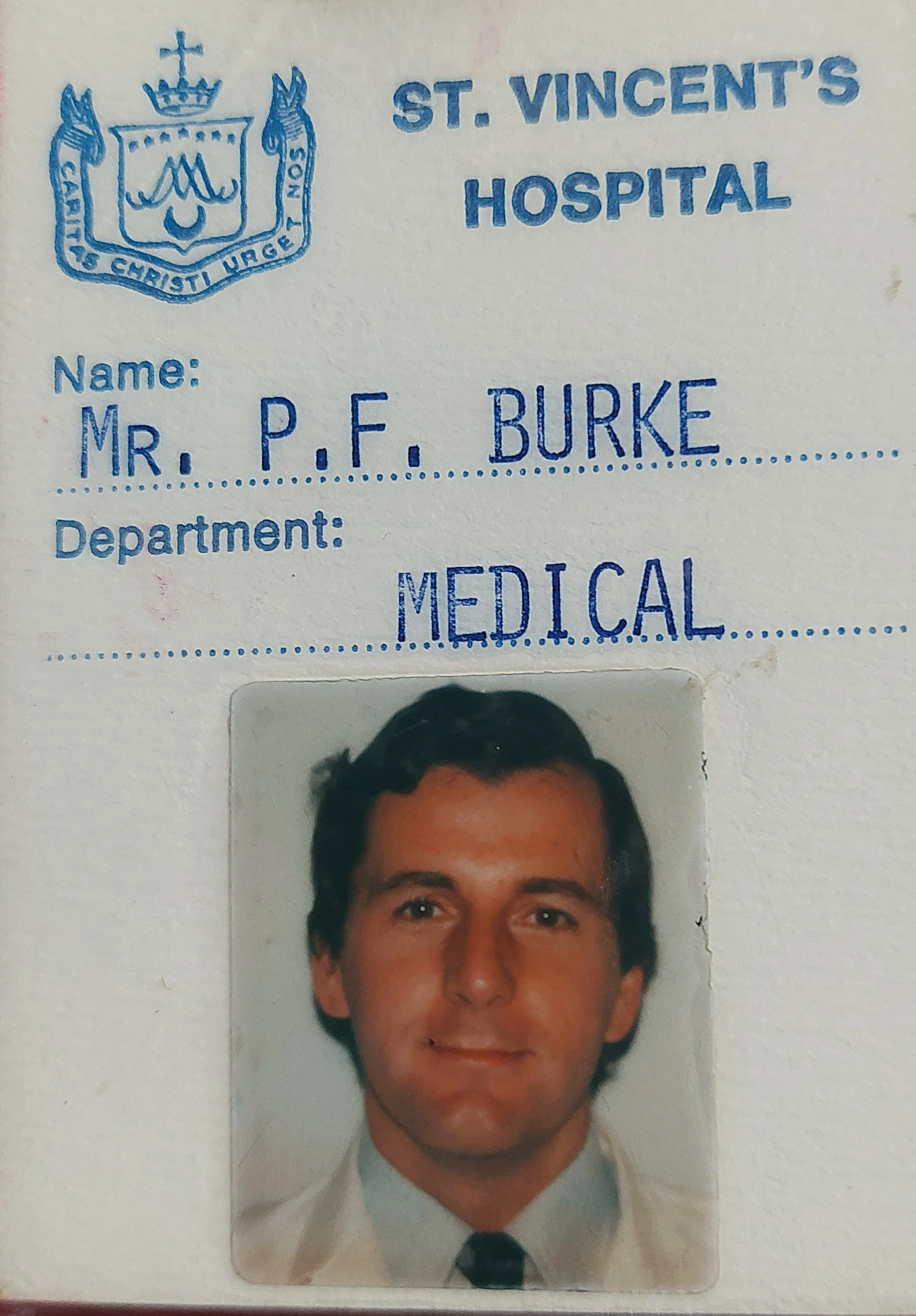
I had followed the usual surgical training for the time, gaining the FRACS at St Vincent’s Hospital, Melbourne in 1977, prior to spending several years working in the British NHS, gaining the FRCS (Eng), as well as the DHMSA, a specialty diploma in the history of medicine from the Society of Apothecaries.
Returning to Melbourne in 1979, at St Vincent’s Hospital the position of Director of Casualty Medical Services was available, and I accepted the position: in 1981 the Australasian Society for Emergency Medicine (ASEM) was established, from its outset I was involved, as with the ACSVH.
A week-long seminar on Major Trauma was conducted at Princess Alexandra Hospital, Brisbane, in November 1982. The meeting was opened by the Governor of Queensland, immediately followed by the keynote address, ‘The Value of Regionalised Trauma Care’ delivered by Professor Donald Trunkey, Chief of Surgery, University of California, San Francisco.
After morning tea, a plenary session proceeded with five speakers, including Noel Stevenson, who spoke on ‘Ambulance Transport’, and myself addressing the topic of ‘Mass Casualties-a Disaster Programme.’
In July 1983 the annual meeting of the Australasian Society for Emergency Medicine was held at the ‘Iluka’ resort, Surfers Paradise, Queensland. There were two excellent overseas visitors, Mr Peter London from the United Kingdom and Professor Glenn Hamilton from the US.
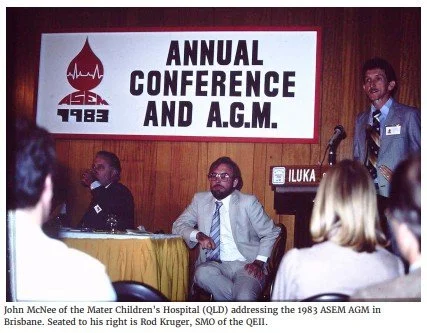
ASEM AGM 1983: image published in From Strength to Strength: The first 35 years of the Australasian College for Emergency Medicine, 1983–2018.
Just days prior to this meeting I was in receipt of a letter from the incoming President of the Royal Australasian College of Surgeons, who wrote:
‘Dear Peter/ My predecessor, John Clarebrough, has handed on to me the documents that you kindly sent to him regarding the move by the Australian Society for Emergency Medicine to form a college.’
‘This was considered at Council last week, and I have written to Mr (Tom) Hamilton telling him that we had approved in principle the establishment of a joint diploma with the Royal Australasian College of Physicians, although we were not able to speak for the sister College at this stage.’
‘I agree with your comments that events have probably overtaken us in this, and it appears that a college is going to be formed. However, Council took the view that the Society should be aware of our discussions with the College of Physicians and for the joint diploma as an alternative to consider.’
‘Thank you for your help in this matter. I return the documents, as you requested.
Yours sincerely Mervyn Smith, President.’
“All portents now indicated that the birth of the Emergency Medicine College of Australasia was imminent! ”
All portents now indicated that the birth of the Emergency Medicine College of Australasia was imminent!
On June 20, 1983 I was able to attend the St John Oration in Melbourne, ‘First Aid and its Variations in Time, Place and Technique’, delivered by Mr London, Senior Surgeon, Birmingham Accident Hospital; subsequently on June 23, he addressed a meeting convened by the Australian Society of Critical Care Medicine and the ACSVH, on ‘The Organisation of Trauma Care’.
These were marvellous opportunities to get to know Mr London, who, as his subsequent obituary notes, was ‘an imposing, upright, immaculately dressed and moustachioed speaker at numerous meetings both in the UK and worldwide: he introduced himself as ‘London, Birmingham’, to the amusement of those lucky enough to be present’.
Subsequently in Surfers Paradise I met Professor Glenn Hamilton MD FACEP, Emergency Department Chair at Wright State University, Dayton Ohio.
Recently I queried Glenn’s recollections of that 1983 visit; he replied, inter alia, ’I can say my visit began with an inquiry by Des Owens, a wonderful man, who we hosted later in the US.’
Desmond Owens had become director of the new emergency department at the Queen Elizabeth Hospital, Adelaide, in 1980, and went on to become not only a Foundation Fellow of the ACEM but also the first Censor-in-Chief, 1983-1985.
““It was an uphill battle, and one of my often-used phrases was “every new growth on the body of Medicine is not malignant”.’”
Glenn continued: ‘I'd been a Department Chair at Wright State for a few years and deeply involved in establishing the credentials of EM within the House of Medicine, especially in the areas of education at all levels of training. It was an uphill battle, and one of my often-used phrases was "every new growth on the body of Medicine is not malignant”.’
The ASEM 1983 ASM was an extremely well attended meeting, with some 120 delegates, and completely positive in every respect: the presentations by both overseas visitors, Peter London and Glenn Hamilton, were extraordinarily well received.
The ASEM AGM was held on the last day, Friday 8 July 1983, and addressed by Tom Hamilton FRCS(Ed) who spoke of the deliberations and discussions that ultimately lead to the decision to form the ACEM as a standalone organisation.
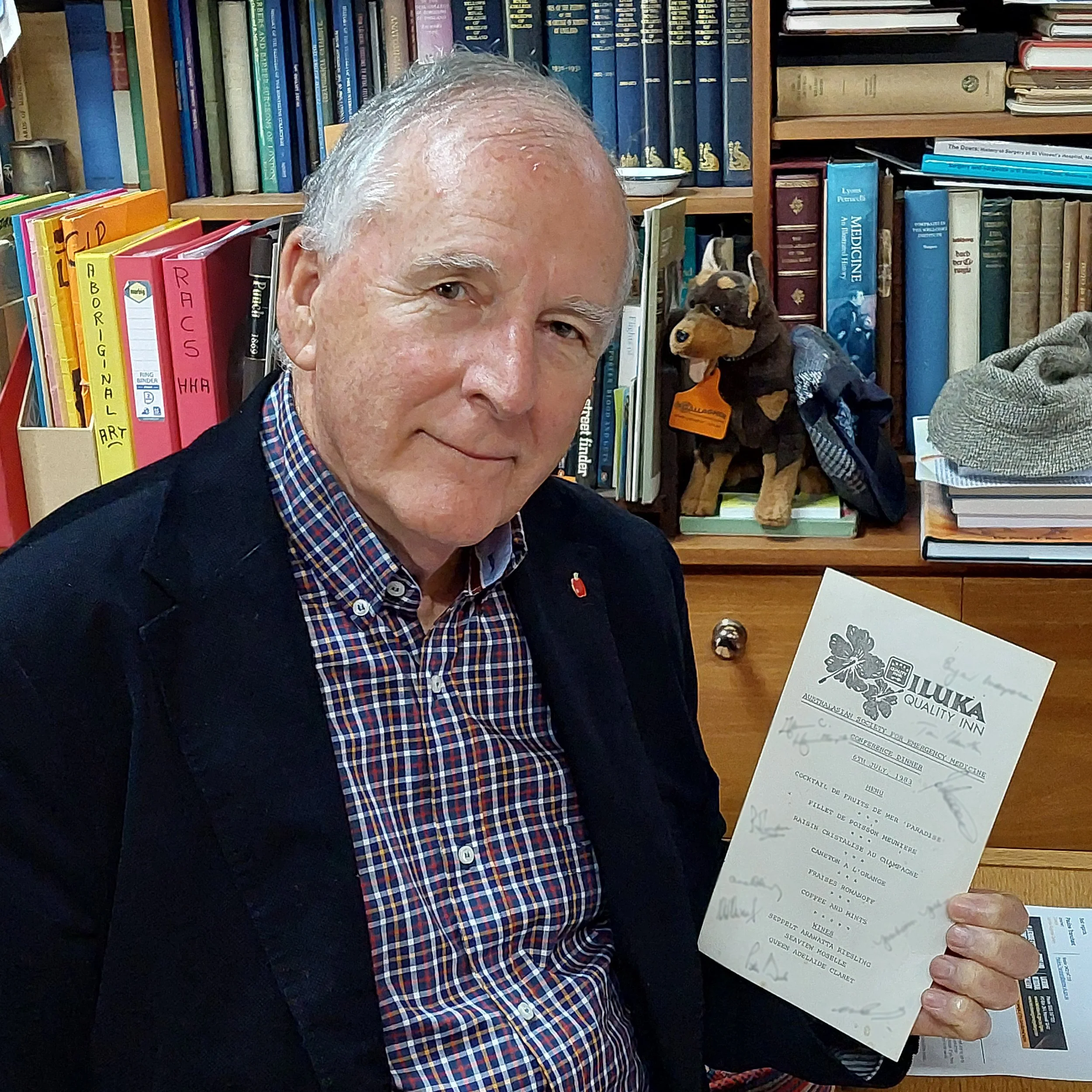
As I was a member of the RACS Archives Committee, Tom, as first ACEM President, requested that I should be the archivist of the new college. We decided that some form of memorabilia should be assembled: a start was made with signed menus from the ASEM Conference Dinner on July 6.
I then wrote to the RACS President advising him of the formation of the ACEM, subsequently receiving the following reply:
‘Dear Peter/ Thank you for your letter with the news that the Australasian College for Emergency Medicine has been formed.
I was pleased to see that you have been named as one of the Founder Fellows and Archivist, and I write now to tell, as you would know, that I hope for a cordial relationship with the new body.
Yours sincerely, Mervyn Smith, President.’
“We decided that some form of memorabilia should be assembled: a start was made with signed menus from the ASEM Conference Dinner on July 6. ”
Coincidentally, I received a letter dated 4 July 1983 from Gordon Trinca OBE, Chair of the RACS National Road Trauma Committee, advising me of my appointment as RACS representative on the Consultative Council on Emergency and Critical Care Services, chaired by Sir Benjamin Rank. I served on that Council with my good friend and fellow FACEM, Joseph Epstein.
In June 1984 I provided a very comprehensive paper for the Community Surgical Services Standing Committee of the RACS entitled ‘Surgical Disaster and Mass Casualty Program’.
The cross pollination of specialty colleges continued, as illustrated by the RACS meeting in Adelaide in May 1986, where an opening Plenary Session was conducted on ‘The Management of Major Blood Loss due to Trauma’.
In order, the speakers were:
‘Prehospital Care and Initial Resuscitation’-- Garry Phillips FACEM FFARACS
‘The Mechanics of Volume Replacement’-- Paul Gaudry FACEM AM MBA
‘Clinical Assessment and Decision-Making’-- Peter Burke FACEM FRACS
Around this time, I became increasingly frustrated with the inflexibility of Saint Vincent’s Hospital, Melbourne, regarding significant redevelopment of the Accident and Emergency services, and finally resigned as Director.
For many years subsequently I maintained my strong association with the ACEM, participating as an examiner, attending College meetings, and contributing to the purchase of the ACEM’s first office in 1993: ultimately in 2003 receiving the ‘Foundation 20 Medal’, awarded by ACEM Council in appreciation of my contributions over the period 1983-2003.
In 2012 I was elected a Fellow of the Australian Medical Association, ‘in recognition of outstanding services to the Association and as a mark of the high esteem in which he is held by Fellow Members’: I was proud to wear the ACEM academic gown and bowtie at that presentation ceremony.